
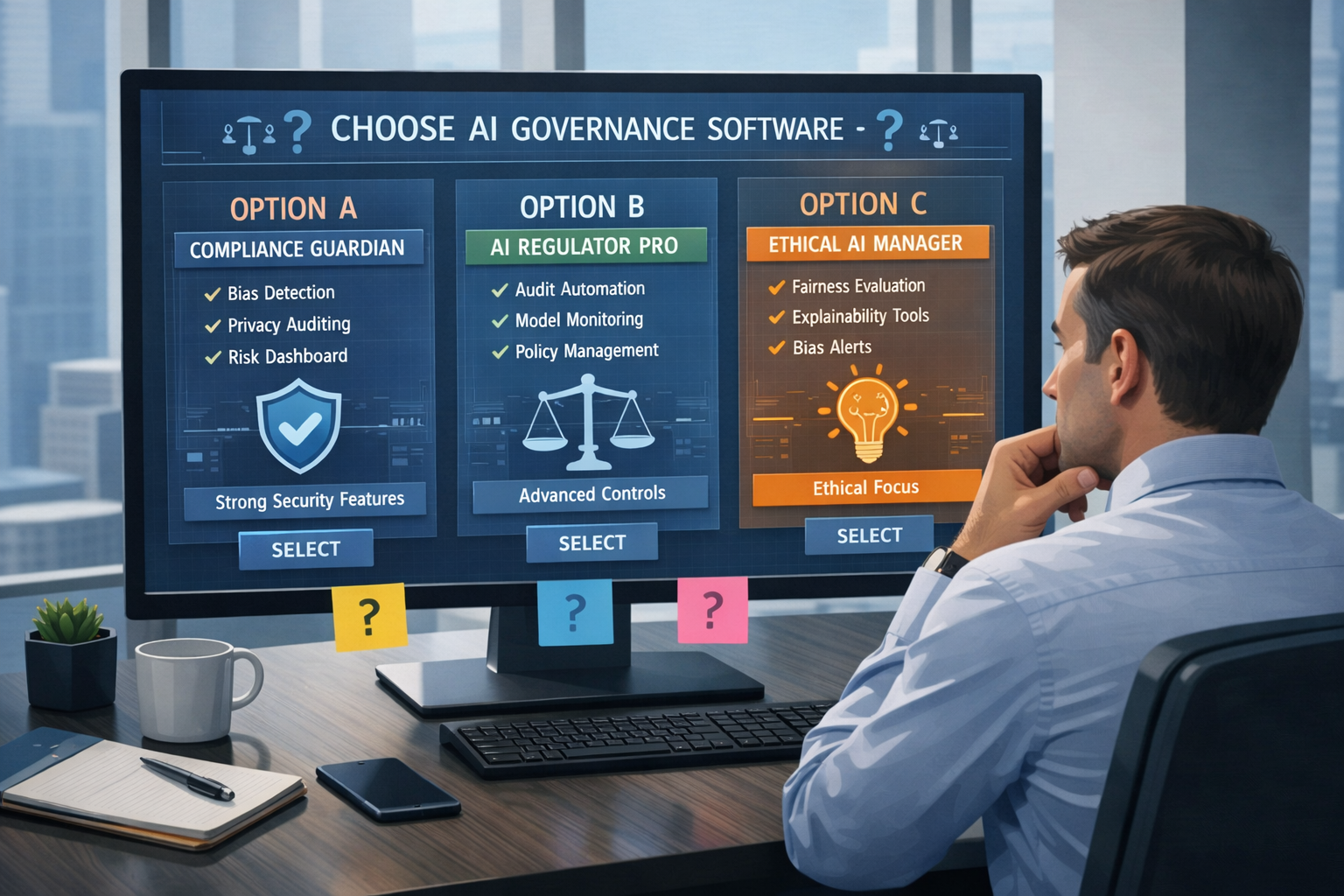


- AI governance software platforms promise to automate compliance tracking, but AI governance is not easy for most organizations to automate
- The real work of AI governance—creating policies, building stakeholder buy-in, defining processes—can’t be automated away
- Many leaders are looking to SaaS solutions as a substitute for very hard work
- Most organizations waste money buying platforms before they understand what they’re actually trying to govern
Our clients often ask us whether they should invest in dedicated AI governance SaaS solutions. There are now dozens of these in the market, and more startups seem to pop up every month.
Let’s spend some time talking about whether this might be a good fit.
What AI Governance Software Actually Does
AI governance platforms typically offer four core capabilities:
- Inventory management for tracking AI systems across the organization
- Risk assessment workflows for evaluating new AI deployments
- Compliance documentation that maps controls to regulatory requirements
- Vendor management tools for due diligence on third-party AI providers
These are genuinely useful features—if you already have the foundational governance framework in place.
The platforms don’t tell you what your AI use policy should say. They don’t build relationships between compliance and engineering teams. They don’t help you figure out whether your organization should be using ISO 42001 or the NIST AI Risk Management Framework.
They’re database systems with workflow automation. Powerful database systems with smart workflow automation, but database systems nonetheless.
When You Actually Need Governance Software
There’s a point where manual tracking becomes untenable. If you’re managing 50+ AI systems across multiple business units, tracking everything in spreadsheets will eventually break down. If you’re subject to multiple overlapping regulations and need to demonstrate compliance across all of them, manual documentation becomes genuinely difficult.
But most organizations aren’t there yet.
Most organizations have 5-15 AI systems in production and maybe another 10-20 in pilot or shadow IT use. That’s completely manageable with Google Sheets, shared drives, and regular check-ins with functional leaders.
The tipping point usually comes when one of three things happens:
- You’re managing dozens of AI systems and can’t manually track compliance status
- You’re operating in heavily regulated industries where audit requirements demand sophisticated documentation
- You have distributed AI governance responsibilities across multiple locations or business units and need centralized visibility
If none of those describe your situation, you probably don’t need specialized software yet.
The Real Cost of Buying Too Early
The obvious cost is financial—these platforms typically run $50,000 to $200,000 annually depending on organization size and feature set. That’s not trivial.
But the hidden cost is worse: buying software before you understand your governance needs often leads to implementing someone else’s framework rather than building what actually works for your organization.
Every platform embodies assumptions about how AI governance should work. The risk categories they use. The approval workflows they enforce. The documentation they require. When you adopt a platform early, you tend to adopt those assumptions by default.
Sometimes that’s fine. But often it means your governance system is optimized for the software vendor’s average customer rather than your organization’s specific needs.
I’ve seen this pattern repeatedly: organizations buy platforms, spend months configuring them, train employees on the workflows, and then realize the whole system doesn’t actually fit how their business operates. They either abandon the platform or—worse—continue using it even though it’s creating unnecessary friction.
What to Do Instead
Start by building your governance foundation without specialized software. Create your AI inventory in a spreadsheet. Write your policies in Google Docs or Word. Track vendor relationships in your existing contract management system. Document risk assessments in whatever format works for your team.
This feels primitive compared to buying a sophisticated platform. It is primitive. That’s the point.
Working with basic tools forces you to think through what you’re actually trying to accomplish. What information do you need about each AI system? What questions matter in your risk assessments? What approval workflows make sense for your organization?
Once you’ve answered those questions through hands-on experience, you’ll know exactly what you need from software. You’ll be able to evaluate platforms based on how well they support your specific governance approach rather than hoping their approach happens to fit your needs.
The analogy I use with clients is hiring. You don’t hire a full-time employee and then figure out what work they should do. You first understand what work needs doing, then hire someone with the right skills to do it.
The same principle applies to software. Do the work manually first. Then automate what’s proven valuable.
Building Toward the Right Solution
The goal isn’t to avoid specialized software forever. The goal is to buy it at the right time for the right reasons.
Good governance software genuinely helps organizations operate more effectively once they’ve reached the point where manual processes can’t scale. It provides visibility that’s otherwise impossible. It catches compliance gaps that would slip through in spreadsheet-based systems. It makes audits dramatically easier.
But it can’t replace the foundational work of building stakeholder relationships, creating clear policies, and developing organizational muscle around AI risk management.
Do that work first. Buy software when you’ve outgrown manual tools, not because buying software feels like progress.
Your future self—and your budget—will thank you.
About the Author
John Rood is the founder of Proceptual, where he helps organizations build practical AI governance systems that actually work. He has taught AI governance at Michigan State University and the University of Chicago. His writing has appeared in HR Brew and Tech Target, and he has spoken at the national SHRM conference.
